Why San Jose Is the Opposite of Every Other U.S. City (And What It Means for Buyers)
Think San Jose works like every other U.S. city? Think again. 🏙️

Most people assume American cities follow a predictable script: a bustling downtown core, concentric rings of sprawling suburbs, a massive web of highways, and neighborhoods that push further and further outward as demand climbs. If you understand one major U.S. metro, you can usually figure out the rest.
San Jose doesn’t play by those rules.
Operating entirely outside the standard urban playbook creates unique dynamics, distinct pricing structures, and hidden pitfalls that catch relocating buyers off guard. For anyone planning a move to the South Bay, understanding these differences changes everything about how you shop, compete, and invest.
🎥 Watch the full video here: https://youtu.be/dwWz8Ex293g
Why San Jose Is The Opposite Of Every U.S. City
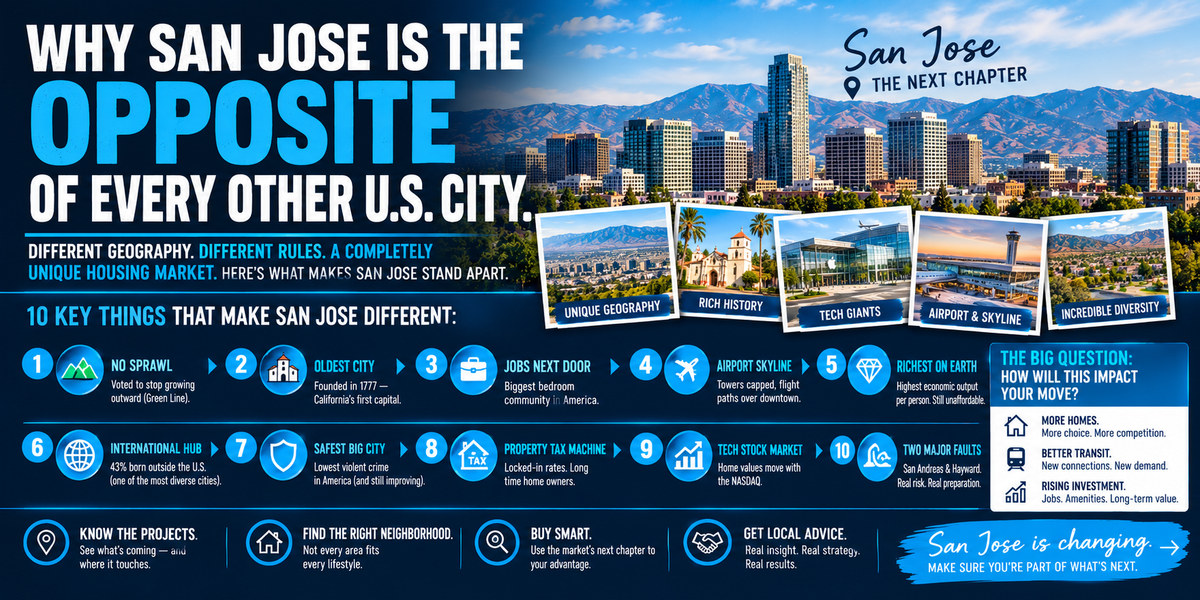
1. The City That Voted to Stop Growing Outward
When housing demand spikes in most American cities, developers build outward into surrounding land. San Jose lacks that option—by choice.
Boxed in by the Diablo Range to the east, the Santa Cruz Mountains to the west, and the San Francisco Bay to the north, the city drew a hard line in 1996 known as the Green Line. In 2000, voters locked that urban growth boundary into the city charter with an overwhelming 81% of the vote. Later, the city invested roughly $93 million to acquire Coyote Valley—land originally slated for 25,000 homes—and unanimously voted to protect 3,200 acres from development permanently.
- What it means for buyers: Land scarcity here isn't a clever marketing slogan; it's a voter-mandated reality. Growth happens inward, making location value a game of which specific neighborhoods absorb density and which remain insulated.
2. California’s Oldest City Disguised as a Tech Hub
While many assume San Jose materialized overnight alongside the microchip, it is actually the oldest civilian town in California. Founded as El Pueblo de San José de Guadalupe on November 29, 1777—predating both Los Angeles and San Francisco—it served as California’s very first state capital after statehood in 1850.
- What it means for buyers: You are shopping in a 250-year-old settlement layered over with a cutting-edge global tech economy. That's why you'll find century-old bungalows in Willow Glen sitting just blocks away from brand-new construction. Knowing the age and structural history of a property matters immensely here.
3. The Ultimate "Bedroom Community" for Billion-Dollar Tech Giants
In a typical metro area, the central city houses the jobs while the surrounding suburbs provide the housing. San Jose completely reverses this formula.
With a population approaching one million, San Jose has more residents than San Francisco, yet the world’s most valuable tech companies are headquartered in the smaller towns right next door: Apple in Cupertino, Google in Mountain View, Nvidia in Santa Clara, and Meta in Menlo Park.
Consider the math: San Jose features roughly 0.8 jobs per employed resident, whereas Palo Alto sits above three, and Cupertino and Mountain View near two. Roughly 98,000 more workers live in San Jose than there are local jobs, meaning the largest city in the Bay Area empties out every morning toward its smaller neighbors.
- What it means for buyers: A neighborhood's value here isn't determined by its proximity to downtown San Jose, but by your commute direction at 8:00 AM.
4. A Skyline Capped by an Airport
Every major city has a towering downtown skyline signaling its financial center. San Jose’s tallest building tops out at roughly 300 feet because federal airspace rules strictly cap building heights due to the flight path running directly over the city center. (Even after years of advocacy, the city managed to raise height limits by a mere 5 to 35 feet). Furthermore, the airport maintains a strict curfew from 11:30 PM to 6:30 AM—the only major Bay Area airport with such a restriction.
- What it means for buyers: Downtown vertical living looks entirely different here, with mid-rises and townhomes taking the place of massive skyscrapers. Consequently, downtown condos often trade at a distinct discount compared to single-family detached houses.
5. The Richest Place on Earth Where a Starter Home Requires Seven Figures
Oxford Economics ranks San Jose as having the highest economic output per person of any city on the planet, not just in America. The median household income hovers around $165,000—the highest of any major metro in the country.
Yet, that economic power collides with severe supply constraints. Redfin data indicates that a household needs roughly $424,000 a year to comfortably buy a median-priced home in San Jose, where 71% of properties are valued at $1 million or more.
- What it means for buyers: Being wealthy by national standards often positions you as a first-time buyer operating on a strict budget here. Success requires a hyper-targeted strategy rather than standard assumptions.
(Want to cut through the guesswork? Take the free San Jose Neighborhood Match Quiz—11 quick questions mapping your budget, commute, and lifestyle directly to the right pocket of the city.)
6. The Most International Big City Outside Miami
While immigrants enrich every major U.S. city, San Jose takes diversity to another level: nearly 43% of residents were born outside the United States, and roughly two out of every three workers in the local tech workforce originated abroad. The city is also home to one of only three historic Japantowns left in the country.
- What it means for buyers: Neighborhood values are frequently tied to tight-knit cultural communities, local markets, and community hubs rather than just standard school district metrics. It also explains the prevalence of multi-generational households and homes purchased to accommodate extended families.
7. The Safest Big City in America
Conventional wisdom dictates that population growth brings a spike in crime rates. San Jose repeatedly defies this narrative, ranking among the safest major cities in the U.S. with violent crime rates dropping significantly and homicide numbers holding near historic lows despite a population of one million.
- What it means for buyers: Asking "is this city safe?" is the wrong starting point. The better question to ask is how specific micro-neighborhoods feel block-by-block and hour-by-hour.
8. The Property Tax Time Machine (Proposition 13)
California’s Proposition 13 locks property tax assessments to the purchase price, allowing increases of no more than 2% a year. Santa Clara County assessor data highlights the stark impact: a small percentage of long-term owners hold a fraction of the tax burden, while buyers purchasing today face base property tax rates hovering around 1.2% of the purchase price annually.
- What it means for buyers: Your tax baseline is established the day you close. More importantly, because current owners enjoy exceptionally low annual tax obligations, nobody has a financial incentive to sell. The typical San Jose homeowner stays put for nearly 19 years—the second-longest tenure of any major U.S. city—leaving overall housing inventory hovering at a tight 6 weeks of supply.
9. A Housing Market That Trades Like a Tech Stock
In most cities, housing markets respond strictly to shifts in mortgage rates. In San Jose, local real estate moves in tandem with the NASDAQ. When tech stocks faced a downturn, local home values adjusted swiftly; when the artificial intelligence boom accelerated, prices surged back to record highs.
While cash buyers represent roughly 1 in 5 transactions (below the national average), the market is heavily fueled by substantial down payments, stock option grants, and buyers comfortable waiving contingencies.
- What it means for buyers: If you are a financed buyer relocating from another region, you aren't just competing against cash offers—you are competing against substantial equity reserves and buyers capable of bridging appraisal gaps using liquid stock assets.
10. Living Between Two of the World’s Most Dangerous Fault Lines
San Jose sits directly in the active corridor between the San Andreas Fault to the west in the Santa Cruz Mountains and the Calaveras and Hayward fault systems to the east.
- What it means for buyers: A pristine online listing photo doesn't tell the whole story. Savvy buyers look closer at four critical factors:
- Ground Liquidation Risk: Soil composition varies dramatically across the valley (with higher risk zones found in areas like Alviso).
- Structural Retrofitting: Ensuring older raised-foundation homes are properly bolted and braced.
- Earthquake Insurance: Understanding policy deductibles (often 15%) and annual premium costs.
- HOA Financials: Reviewing comprehensive reserve studies and mandatory balcony inspection compliance reports for condos and townhomes.
Making Your Next Move
San Jose operates by its own distinct set of rules. The geography, tax structures, commuting currents, and buyer competition models are unlike anywhere else in the country. Understanding these realities before you make an offer ensures you make a confident, well-calculated investment rather than learning expensive lessons after closing.
Planning a move to the South Bay? Let’s talk through your timeline, budget, and commute to build a clear, numbers-first strategy tailored specifically to your goals.
Why San Jose Is The Opposite Of Every U.S. City