San Jose Suburbs Real Estate Market: Which Areas Are Cooling Off and Which Are Taking Off?
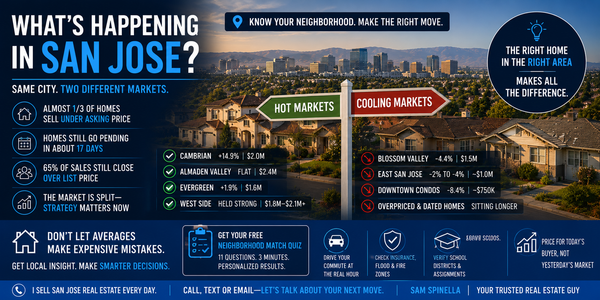
San Jose real estate isn't crashing—it’s splitting in two. 📈

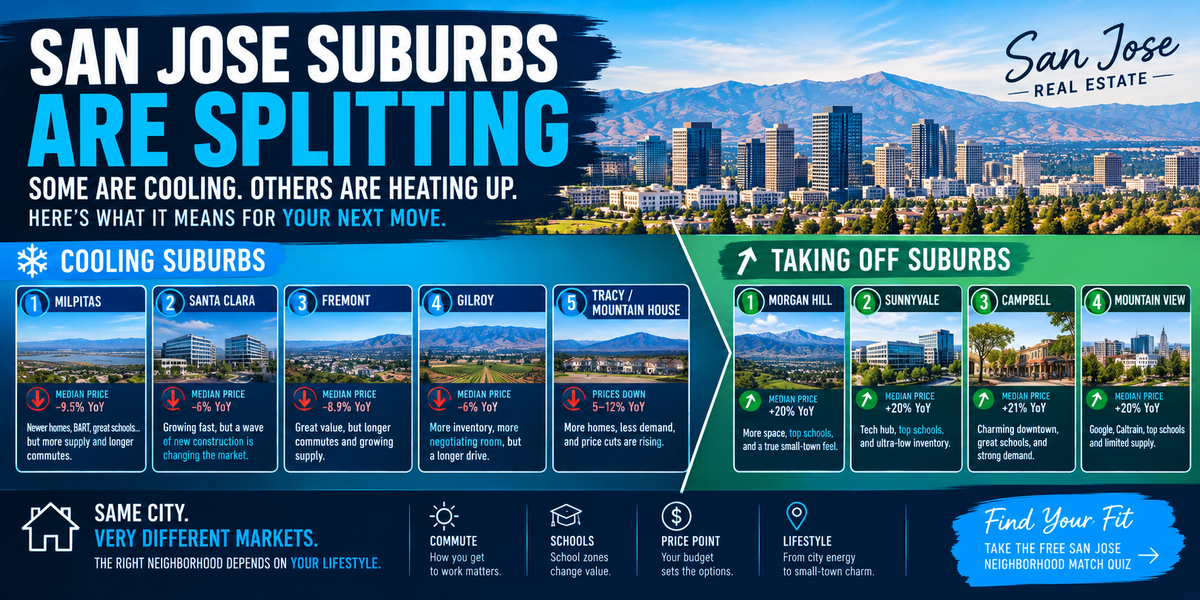
If you’ve been watching the San Jose housing market, you’ve likely noticed a shifting landscape. Some of the region’s most sought-after suburbs aren't experiencing the frantic, hyper-competitive bidding wars they were a couple of summers ago. So, what’s actually happening, and where is buyer demand going instead?
Recent MLS data, Redfin, Zillow, and local market reports highlight a clear split in the Silicon Valley real estate market. Let’s break down which San Jose suburbs are cooling off, which ones are heating up, and what this means for your next real estate move.
🎥 Watch the full video here: https://youtu.be/7QoFKXE0fyg
San Jose Suburbs Everyone is LEAVING!
Part 1: The San Jose Suburbs That Are Cooling Off
"Cooling off" doesn't mean these are bad places to live. Instead, it means that inventory has opened up, price growth has softened, and buyers finally have some breathing room to negotiate.
1. Milpitas
- The Appeal: Milpitas skyrocketed in popularity when the BART station opened, offering great schools like Milpitas High and a more attainable alternative for townhome buyers.
- The Shift: Massive new construction around the Great Mall and BART station—slated for roughly 7,000 new units—has flooded the market with townhomes and condos. Redfin data puts Milpitas' median sale price down about 9.5% year-over-year.
- The Nuance: The cooling trend is heavily concentrated in attached housing. Detached single-family homes in July still went under contract in about 17 days due to low supply.
- What it means for buyers: If you want a townhome near BART, you can finally compare multiple options, negotiate, and ask for seller credits—things that were nearly impossible a few years ago.
2. Santa Clara
- The Appeal: Santa Clara is actually the fastest-growing city in the county. It sits right next to Nvidia’s headquarters, Levi’s Stadium, and Santana Row, while offering some of the most accessible single-family entry points among core cities.
- The Shift: Because of its prime location, builders went all-in. Major projects like Tasman East, Related Santa Clara, and Mission Point are introducing thousands of new homes. Active single-family listings jumped over 150% this July compared to last year, pushing days on market from 16 to 27.
- What it means for buyers: While homes still sell over asking (averaging about 105%), Santa Clara is shifting from "very hot" to "merely warm." It’s an ideal spot to secure a three-bedroom house near major tech hubs with more than one option to look at.
3. Fremont
- The Appeal: Historically a go-to choice for San Jose buyers looking for newer construction, top-rated schools like Mission San Jose High, and BART access at Warm Springs.
- The Shift: Detached homes in Fremont hit a median of about $1.54 million this August—down nearly 9% year-over-year—while active listings are up 25%. Aside from new condo supply in Warm Springs, the daily commute (fighting traffic across the Sunol Grade or I-880) is causing buyers to pause. (Note: With Tesla converting its Fremont plant to build robots rather than closing, the local job base remains secure.)
- What it means for buyers: Fremont is officially a negotiating market. If your job is local or you're a true hybrid worker, you’re getting more house per dollar. If you commute to San Jose daily, test drive the morning commute before making an offer.
4. Gilroy
- The Appeal: Long considered the South Bay’s ultimate value play, offering large new homes in master-planned communities like Glen Loma Ranch and Eagle Ridge, wine country scenery, and a historic downtown for around $1.1 million.
- The Shift: Gilroy became the one market in Santa Clara County sliding below asking price, with a July median of $1.1 million (down 6% year-over-year). Days on market stretched to 45 days, and new construction at Glen Loma Ranch and Hecker Pass is competing heavily with resale homes. Combined with ongoing highway interchange construction and warmer summers, buyers are taking their time.
- What it means for buyers: Gilroy offers some of the highest negotiation leverage in the region, including seller credits and repair concessions. Just be sure to verify school boundary performance and factor in local Mello-Roos taxes.
5. The Exurbs (Tracy, Mountain House, Hollister, Los Banos)
- The Appeal: These towns experienced an explosive boom during the remote work wave when an 80-minute commute felt optional.
- The Shift: The market has completely flipped. Zillow values in Tracy are down 5% to 12%, Hollister’s inventory is up 65%, and the share of homes selling over asking dropped significantly. Many families who bought out here during the peak are now listing their homes to move closer back in.
- What it means for buyers: If your job is genuinely remote or located in the Central Valley, you have incredible purchasing power. However, if you face a 90-minute daily commute to San Jose four days a week, weigh the lifestyle trade-offs carefully.
Part 2: Where Is All the Demand Landing?
When buyers realized that Milpitas, Santa Clara, Fremont, Gilroy, and the exurbs weren't as fiercely competitive, that capital redirected toward core markets that many had previously written off as too expensive or compact.
1. Campbell
- The Data: Single-family homes sold at a median of around $2.4 million this July—up about 21% year-over-year—with days on market dropping to 19.
- The Why: Campbell has what cooling suburbs lack: almost zero new supply. As a built-out town with a vibrant downtown and farmers market, priced-out buyers from Los Gatos or those ditching long commutes flood into the same limited inventory.
- What it means for buyers: Campbell requires swift preparation. Come pre-approved, know your numbers, and be ready to make a decision within days.
2. Mountain View
- The Data: Single-family homes closed around $3 million this July, up over 20% year-over-year, with a fast turnaround of about 10 days on market.
- The Why: As the urban core of the Peninsula's job market—anchored by Google, a walkable Castro Street, and electrified Caltrain—land within a bike ride of major tech campuses is fiercely limited.
- What it means for buyers: If you want a walkable, transit-oriented lifestyle, don't expect the heavy negotiating leverage found in outlying areas. You’ll need to move fast and bring a strong offer.
3. Sunnyvale
- The Data: Sunnyvale saw the biggest inventory drop of any city in the county, with active single-family listings down 30% to just 25 homes in July. Pending sales surged nearly 50% year-over-year, and median prices hovered around $2.8 million.
- The Why: Major economic investments are driving demand. Google expanded its presence with a massive new campus and renewed millions of square feet at Moffett Place, Amazon took over former office space, and LinkedIn and Apple remain deeply rooted. Combined with A+ schools like Homestead High, electrified Caltrain service, and top-tier safety rankings, people are choosing Sunnyvale deliberately.
- What it means for buyers: If your budget reaches Sunnyvale, it remains one of the safest bets in the South Bay. Many buyers purchase older 1950s ranches to renovate over time. Always verify exact school boundaries block-by-block, as lines heavily impact value.
4. Morgan Hill
- The Data: Morgan Hill closed 20% more single-family sales this July on 9% fewer listings, with a median price around $1.4 to $1.65 million and a brisk 16 days on market.
- The Why: Families touring core cities and facing steep prices for smaller homes are discovering that heading 25 minutes south yields twice the house on a larger lot for less money. Offering scenic hillside views, a thriving downtown on Monterey Road, local wineries, and proximity to Henry Co. State Park, Morgan Hill balances small-town charm with strong schools (like Sobrato High).
- What it means for buyers: Morgan Hill is a prime destination for buyers seeking a traditional detached house, a strong school district, and more space without breaking a San Jose budget. Keep an eye on local considerations like fire severity zones and temporary reservoir construction projects.
Summary: What’s Your Game Plan?
- If you're buying in cooling suburbs (Fremont, Gilroy, Milpitas): Take a breath. You have room to negotiate on price, request repairs, and take your time evaluating properties.
- If you're buying in core demand markets (Campbell, Mountain View, Sunnyvale, Morgan Hill): Treat it with urgency. Come pre-approved, know your budget, and be ready to act quickly.
- If you're selling: Price your home realistically for today's market conditions. Overpricing—even in competitive areas like Sunnyvale or Campbell—will cause listings to stall as buyers track the exact same data.
Trying to figure out which neighborhood fits your specific budget, commute, and lifestyle? Take the free San Jose Neighborhood Match Quiz—11 quick questions that match your criteria with results delivered straight to your inbox.
San Jose Suburbs Everyone is LEAVING!