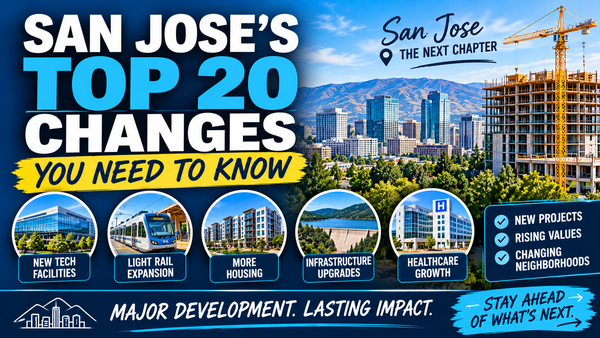
The New California Housing Laws Changing San Jose Home Equity (And a Tour of 2730 Murtha Dr)
California and San Jose recently passed three major laws that directly impact your home equity, your property taxes, and what you're allowed to build on your land. 🏡

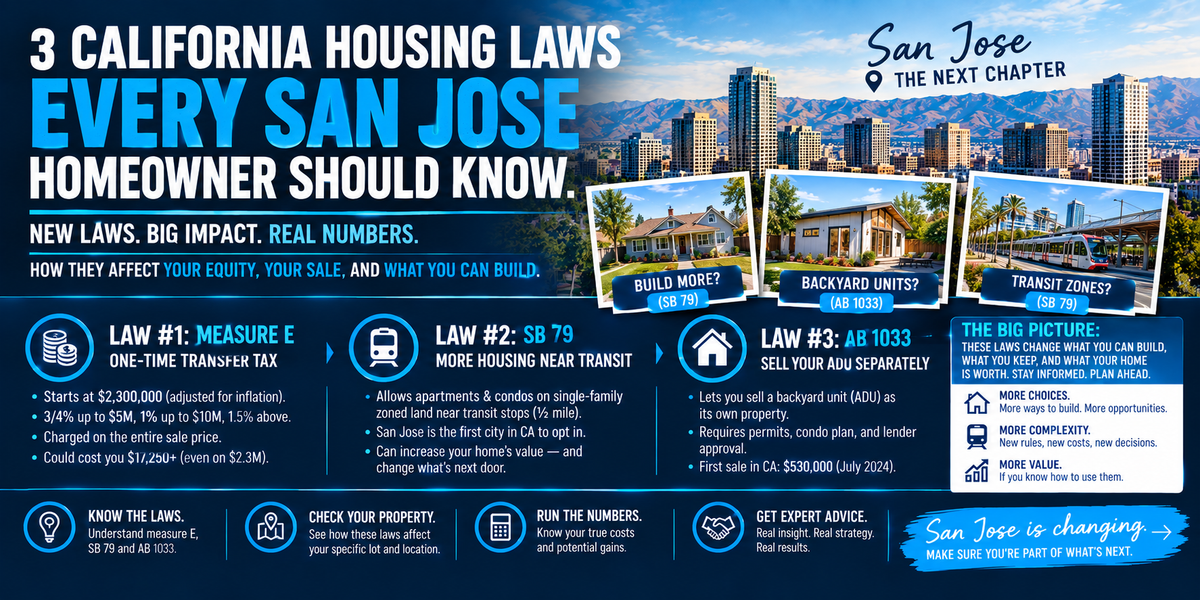
If you own real estate in San Jose, you are sitting on property rights and financial variables you might not even know you have. Recent legislative changes have fundamentally rewritten what homeowners can build on their land, how property transfers are taxed, and what sellers actually walk away with at the closing table.
After 20 years in this market, we break down three major legal shifts impacting San Jose homeowners right now—alongside an exclusive look inside a stunning property listing at 2730 Murtha Drive in East San Jose.
🎥 Watch the full video here: https://youtu.be/55uZRUfBsMA
1. San Jose's Measure E Transfer Tax: The $2.3M "Cliff"
Passed in March 2020, San Jose's Measure E is a voter-approved, one-time tax collected when a property sells, stacked on top of regular city and county transfer taxes. While initially pitched as a "mansion tax" targeting luxury properties and commercial buildings, inflation-adjusted thresholds have brought ordinary single-family homes directly into its crosshairs.
- The Threshold: Effective through 2030, the tax threshold sits at $2,300,000.
- The Rates: For properties selling above that line, rates are 0.75% up to $5 million, 1% up to $10 million, and 1.5% above that.
- The Catch: The tax isn't just charged on the amount above the line—it applies to the entire sale price.
The $17,250 Dead Zone
- If a home sells for $2,300,000, Measure E equals $0.
- If the exact same home sells for just $1 more ($2,300,001), Measure E jumps to $17,250.
When factoring in standard transfer taxes, sellers can easily land in a "dead zone" where a higher gross offer actually nets them less money at closing if the numbers aren't carefully calculated.
- What it means for sellers: Price your home strategically for your net payout, not just the headline price, and negotiate transfer tax splits in writing before signing purchase contracts. (Note: Inherited homes sold via a trust or estate are still subject to Measure E upon sale).
2. Senate Bill 79: Transit-Oriented Density
Signed by the Governor and taking effect recently, SB 79 overrides local single-family zoning restrictions if a property sits within half a mile of a qualifying transit stop (such as light rail stations), allowing apartments and townhomes to be built in traditional single-family neighborhoods.
While the San Jose City Council successfully carved out protections for roughly 6,600 acres of job centers, historic sites, and high fire zones, the broader rule stands.
- What it means for homeowners: If your property sits within a half-mile of a transit station, your lot may carry a completely different valuation to a builder than it did a year ago. Conversely, it also means higher-density developments could eventually arrive next door.
3. Assembly Bill 1033: Selling Your ADU Separately
Back in 2023, California passed AB 1033, allowing cities to opt-in to a historic shift: selling a backyard Accessory Dwelling Unit (ADU) separately from the main house as its own independent condominium. San Jose was the first city in the state to adopt it, and the region already boasts milestone sales—such as a 2-bedroom ADU near downtown closing as an independent asset.
- What it means for homeowners: Your backyard unit is no longer just rental income or a guest suite for aging parents. Under the right conditions, it represents a distinct, separable asset you can sell while retaining the main house. (Note: Doing so requires a formal condo plan, certificates of occupancy, lender sign-offs, and recorded county paperwork).
Featured Listing Tour: 2730 Murtha Drive, East San Jose
Sticking to the core of San Jose real estate, let's step inside 2730 Murtha Drive—a single-story home in East San Jose listed right around $1.1 million (safely below the Measure E threshold).
Unlike quick investment flips designed for a fast turnaround, this home was remodeled by its owners with the intention of living there forever. Every upgrade was executed gradually, with meticulous care, attention to detail, and quality craftsmanship. From the modernized interior living spaces to the pristine backyard layout, it showcases the kind of pride of ownership that buyers search months to find.
Beyond the property lines, East San Jose is experiencing substantial, tangible infrastructure investment. Shovels are already in the ground along the Capitol corridor as VTA builds the Eastridge-to-BART light rail extension (including the new Story Road station), alongside pedestrian and bike corridor enhancements along Alum Rock and Ocala.
What’s Your Game Plan?
Navigating property taxes, transit overlay zones, and ADU potential requires a localized, numbers-first strategy.
- Want to calculate what Measure E means for your specific home equity?
- Curious if your street falls inside the SB79 transit zone?
- Want a tour of 2730 Murtha Drive or guidance on your next real estate move?